National’s wood policy could unleash a green growth juggernaut – Marty Verry
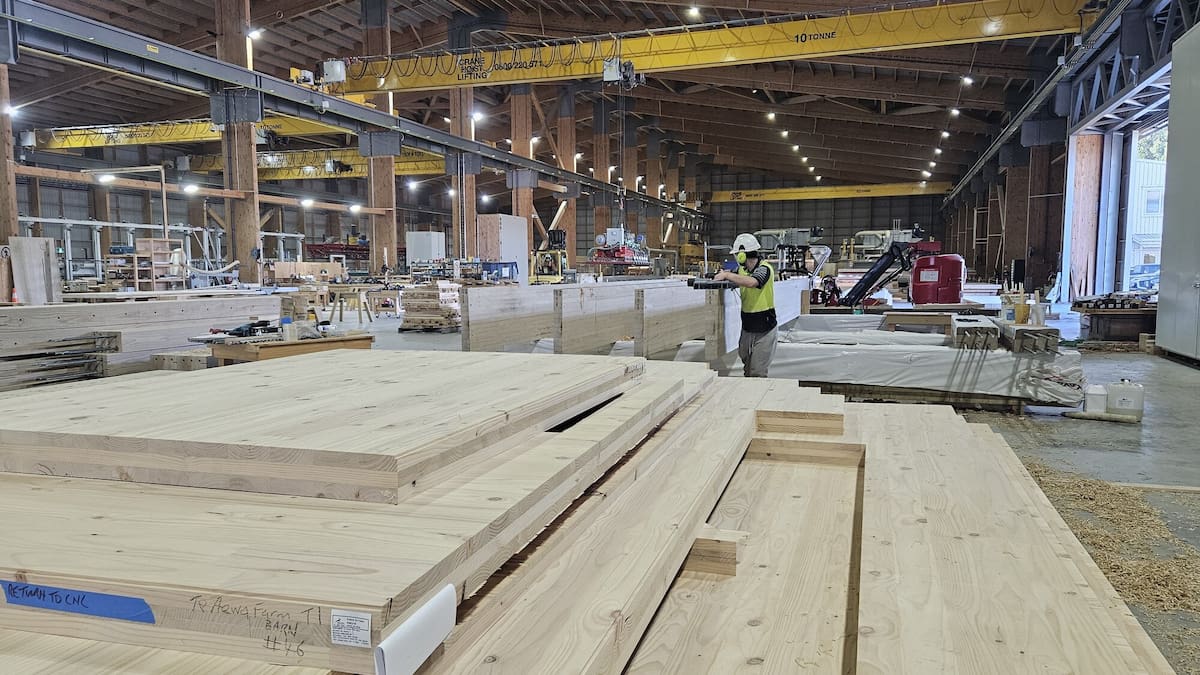
Marty Verry, whose Red Stag group operates a cross-laminated timber factory, argues that National’s proposed policy for government buildings could increase domestic wood processing and reduce the embodied emissions of suitable public projects.
The National Party plans to “back wood in government buildings” with its new wood policy.
This is something I have pushed on behalf of the industry for many years, with varying degrees of success. So, what has changed?
Firstly, the emergence of large-format engineered wood, known as “mass timber”, has opened a huge range of large commercial building types that can be built in wood. The new six-storey Museum Street Building at Parliament is one example.
Secondly, over the past decade, New Zealand engineers and builders have shown that mass timber can be cost-competitive with traditional steel and concrete for suitable projects, particularly when it is factored into the design from the outset.
We are seeing this daily now, with industrial sheds, gyms and halls, office buildings, hotels, retirement homes and student accommodation stacking up in mass timber.
When building designs factor in mass timber from the outset, in our experience, early consideration makes timber more competitive.
The Government rightly recognises that a formal policy ensuring this consideration early in the design process is key to changing behaviour.
Next came the really smart part: the observation that these mass timber buildings are typically up against imported cement and heavy-gauge steel, which Australian-owned NZ Steel does not produce through its electric arc furnace.
Putting all this together, the National Party’s logic becomes clear. The Government is New Zealand’s largest procurer of buildings. It can use that procurement strategically to improve outcomes for NZ Inc. By ensuring mass timber is fairly considered by government-building design teams, the Government’s procurement can back locally owned mass timber processors over imported high-emission imports. This extra demand triggers local investment, scale, jobs and productivity. This could reduce costs over time if greater scale and competition lower processing and construction costs.
Export boost
It also means wood processors have a lower cost base to compete in export markets. New Zealand can transition from an importer of high-emission materials made by foreigners to a global exporter of low-emission domestically made materials.
The balance of payments reversal of fortunes is obvious. As are the benefits of economic sovereignty in what has become a pretty unpredictable world.
It’s a policy that puts Kiwi jobs, businesses and the tax base first.
A greener shade of blue
Then there is the environmental angle. Government analysis has estimated that building-related activity accounts for about 9% of New Zealand’s domestic emissions. Globally, the steel and concrete industries are estimated to contribute 8% of carbon emissions each. Naylor Love modelling found a concrete floor can cause 10 times more emissions than a Red Stag cross-laminated timber (CLT) flooring system.
In pursuing a policy on economic grounds, National has stumbled across a potent sustainability/climate policy.
Environmental impacts can go further still with mass timber buildings. Heard of “biophilic design”? It’s also known as “nature-connected” design, and it is well researched. Such buildings have been associated with improvements in wellbeing and some cognitive measures.
In 2024, property consultancy JLL published research that green-certified office buildings can attract lease and value premiums of up to 9%. Corporates and government departments are keen to demonstrate their climate credentials, create productive workplaces, and attract top young environmentally conscious employees.
Industry modelling by Deloitte found that, if half of New Zealand’s commercial buildings were made from mass timber, the wood processing sector would need to expand to 30 times its current CLT capacity and would double in size overall.
Not a bad outcome for a policy that works primarily through the Government’s existing procurement programme.
Marty Verry is chief executive of the Red Stag group, which has investments in forestry and wood processing and operates New Zealand’s only cross-laminated timber factory. Red Stag could benefit commercially from increased use of mass timber in government construction.
Catch up on the debates that dominated the week by signing up to our Opinion newsletter – a weekly round-up of our best commentary.